COCOBOD ROLLS OUT NATIONWIDE FARMER SENSITIZATION CAMPAIGN ON FREE INPUT DISTRIBUTION AND MAJOR COCOA SECTOR REFORMS
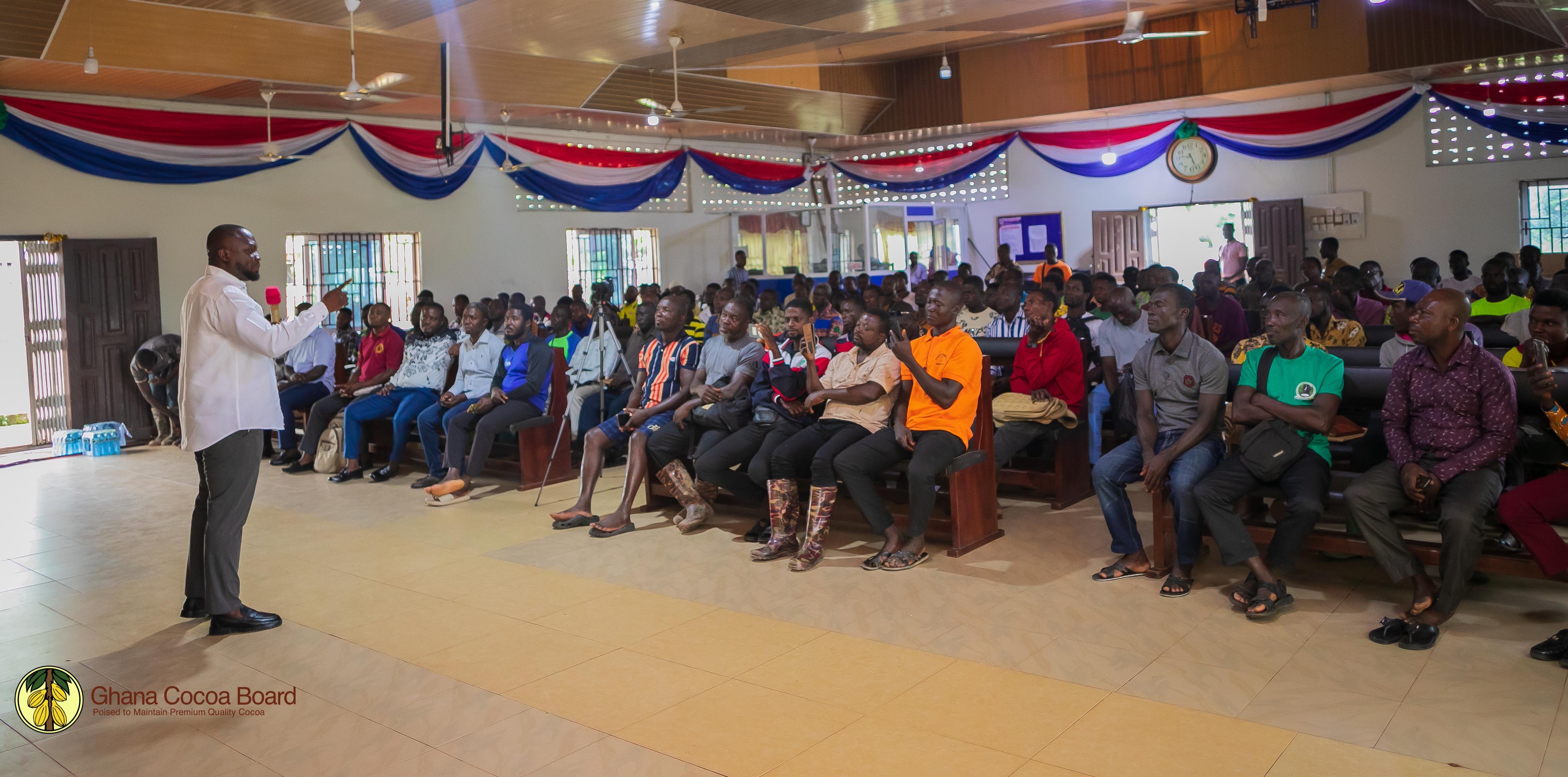
Date: 13th July 2026
The
Ghana Cocoa Board (COCOBOD) has commenced a nationwide farmer sensitization
campaign to educate cocoa farmers on the reintroduced Free Fertilizer and
Agro-Inputs Distribution Programme under the Cocoa Diseases and Pest Control
(CODAPEC/HITECH) Programme, alongside a series of strategic reforms aimed at
revitalizing Ghana's cocoa industry, improving farmer livelihoods, and securing
the long-term sustainability of cocoa production.
The
nationwide exercise, being undertaken by the Public Affairs Department in
collaboration with the Cocoa Pest and Disease Control (CODAPEC) Unit of the
Cocoa Health and Extension Division (CHED), began in the Western South Region
with engagements in the Aiyinase, Huni Valley, Prestea, and Samraboi cocoa
districts, and continued in the Ashanti Region, covering the Tepa, Mankranso,
and Juaso districts.
The
sensitization campaign, which is being rolled out across all cocoa-growing
areas, will ensure that farmers fully understand the new interventions, the
operational modalities of the free input distribution Programme, and the
broader policy reforms being implemented to reposition Ghana's cocoa sector for
sustainable growth.
Addressing
hundreds of cocoa farmers during the engagements, the Deputy Head of Public
Affairs, Mr. Benjamin Teye Larweh, commended farmers for their resilience,
patience, and unwavering commitment to cocoa production despite the economic
and operational challenges that have confronted the sector in recent years.
He
assured farmers that COCOBOD remains firmly committed to restoring confidence
within the industry through deliberate policy reforms, improved stakeholder
engagement, and interventions designed to enhance productivity and improve
farmer welfare.
Mr.
Larweh acknowledged the temporary delays in producer payments, explaining that
they resulted from financing constraints arising from the unprecedented decline
in international cocoa prices. He, however, informed farmers that COCOBOD had
released substantial funds to Licensed Buying Companies (LBCs) to facilitate
the settlement of outstanding producer payments. He expressed confidence that
the payment process would be completed shortly, enabling farmers to reinvest in
their farms ahead of the new crop season.
Touching
on the increasing spread of misinformation surrounding the cocoa sector, Mr.
Larweh cautioned farmers against relying on unverified information or
narratives that have the potential to undermine confidence in the industry. He urged farmers to rely exclusively on
official communication from COCOBOD and its authorized representatives.
"Always
verify information through COCOBOD's official communication channels before
accepting or sharing it. Accurate information is essential to protecting your
livelihoods and safeguarding the integrity of Ghana's cocoa industry," he
advised.
Mr.
Larweh also disclosed that the Board is pursuing comprehensive legislative
reforms through a new COCOBOD Bill currently being prepared for parliamentary
consideration. According to him, the proposed legislation is expected to
introduce far-reaching reforms in producer price determination, crop financing,
institutional governance, and the protection of cocoa farms against illegal
mining and other emerging threats confronting the industry.
He
explained that the reforms form part of the Government's broader agenda to
build a financially sustainable, transparent, and globally competitive cocoa
sector capable of delivering greater value to farmers while maintaining Ghana's
reputation as the world's leading producer of premium-quality cocoa.
Mr.
Larweh also urged cocoa farmers to support ongoing traceability and
sustainability reforms, stressing that Ghana’s cocoa industry must comply with
the European Union Deforestation Regulation (EUDR), the African Regional
Standards (ARS), and other emerging consumer-centred requirements to preserve
access to key markets and maintain the country’s premium cocoa reputation. He
explained that these standards require farmers and other actors across the
value chain to protect the environment, adopt responsible farming practices,
and ensure that cocoa can be traced from the farm to the market.
Providing
details of the reintroduced Free Fertilizer and Agro-Inputs Distribution
Programme, the National Coordinator of CODAPEC, Mr. Seidu Iddrisu Abu,
explained that the intervention represents a significant departure from the
previous subsidized input distribution system.
He
said the new programme introduces a fully government-funded input support
system designed to improve productivity, reduce production costs for cocoa
farmers and ensure a more transparent, equitable and efficient distribution of
fertilizers and other critical agro-inputs.
Mr.
Abu explained that eligibility for the programme is restricted to registered
cocoa farmers with productive cocoa farms captured under the Cocoa Management
System (CMS) and other official means.
He
noted that abandoned farms, moribund farms, farms severely affected by Cocoa
Swollen Shoot Virus Disease (CSSVD), and farms threatened by land-use
conversion through illegal mining, rubber cultivation or residential
development would not qualify for support under the programme.
He
further indicated that fertilizer allocation would be based on scientifically
determined agronomic criteria, taking into account the age, condition and
productivity of individual cocoa farms.
Under
the new guidelines, productive farms will receive three bags of granular
fertilizer per acre, subject to a maximum allocation covering ten acres per
farmer within a jurisdiction. Juvenile farms below four years will receive
foliar fertilizer, while productive farms between four and twenty-two years
will benefit from both granular and foliar fertilizers. Mature farms between
twenty-two and thirty years will receive granular fertilizer to sustain
productivity. He said consideration would be given to farms above 30 years that
show great promise.
Mr.
Abu announced that the programme would be implemented through 247 decentralized
community distribution centres across the country under the supervision of
Community Task Forces.
According
to him, the decentralized model replaces the previous cooperative-based
distribution system and incorporates robust accountability measures, including
communal fertilizer application, retrieval of empty fertilizer sacks,
publication of beneficiary lists and continuous field monitoring to minimize
diversion, eliminate smuggling and ensure that the inputs reach their intended
beneficiaries.
He
appealed to farmers to cooperate fully with District Cocoa Officers, Community
Task Forces, and extension personnel to ensure the successful implementation of
the programme.
He
further reminded beneficiaries that all fertilizers and agro-inputs supplied
under the initiative are intended exclusively for application on cocoa farms
and must not be diverted, sold, or used for any other purpose.
According
to Mr. Abu, the health and safety of all stakeholders in the COPAPEC programme
is of great importance to COCOBOD. As a result, 89,000 personal protective
equipment (PPEs), including wellington boots, overalls, nose masks, hand
gloves, hats, and goggles, are being distributed to spraying gangs across the
cocoa regions. For the first time, society chief farmers will benefit from
this.
Beyond
the inputs and reforms, the campaign also includes education on the tertiary
education scholarship for wards of cocoa farmers scheduled to be implemented in
the 2026/27 academic year. The nationwide sensitization campaign forms part of
COCOBOD's broader communication and stakeholder engagement strategy to place
cocoa farmers at the centre of ongoing sector transformation through timely
information dissemination, transparent programme implementation and sustained
dialogue with farming communities.
Other News / Articles you might be interested in.
GSA AND COCOBOD PARTNER TO EMPOWER LBC EXECUTIVES ON KEY OPERATIONAL STANDARDS
The Ghana Standards Authority (GSA), Ghana Cocoa Board (COCOBOD), and representatives of Licensed ...
Read More
COCOA CAPITAL PLC BOND AND NOTE PROGRAMME
Read More
COCOA CAPITAL PLC UNDERTAKES A BOND AND NOTE PROGRAMME ON GSE
Cocoa Capital PLC, a subsidiary of Ghana Cocoa Board (COCOBOD) created under the ...
Read More