COCOBOD LAUNCHES CLIMATE-SMART COCOA FARMERS BUSINESS SCHOOL CURRICULUM
Date: 14th September 2026
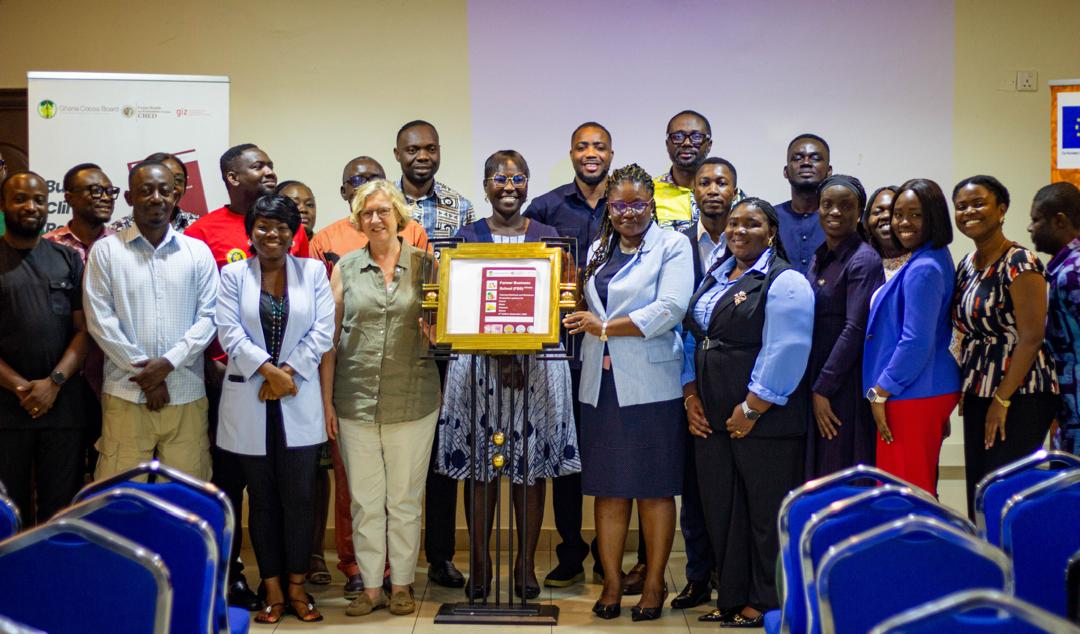
The Cocoa Health and Extension Division (CHED) of the Ghana Cocoa Board (COCOBOD), in collaboration with GIZ, has officially validated and launched the eighth Cocoa Farmers Business School (FBS) Climate-Smart Training Manual.
The launch followed a two-day stakeholder consultation meeting aimed at reviewing and validating the revised FBS curriculum. The updated curriculum incorporates climate-smart agriculture practices alongside core business management skills to equip cocoa farmers with the knowledge and tools needed to manage their farms as profitable and sustainable enterprises.
Speaking at the unveiling ceremony in Accra, GIZ Programme Manager, Beate Weiskopf, expressed satisfaction with the successful completion of the manual, following extensive consultations and engagements with cocoa farmers, development partners and other sector stakeholders.
She commended the revised training manual for its focus on essential business management skills, including record keeping, financial management and basic accounting principles, which are expected to enable farmers to make informed decisions and improve the profitability of their farms.
Madam Weiskopf further noted that the integration of climate-smart agriculture into the FBS curriculum would provide farmers with a comprehensive understanding of climate change adaptation and mitigation measures, as well as environmental management practices. These, she said, would contribute to sustainable cocoa production, strengthen farmers’ resilience to climate-related challenges and improve livelihoods.
She called for the immediate rollout of the climate-smart FBS module across all cocoa-growing regions and urged stakeholders to adapt the training content to accommodate the local language preferences of farmers nationwide. She also encouraged research institutions, development partners, farmer cooperatives and relevant government agencies to continue providing technical expertise and financial support to facilitate the periodic review and upgrading of the curriculum in line with emerging agricultural practices.
The Deputy Executive Director for Extension at CHED, Dr Margaret Ayerakwa, who spoke on behalf of the Executive Director, expressed appreciation to GIZ for its continued support for cocoa farmer development initiatives. She particularly acknowledged the organisation’s longstanding collaboration with COCOBOD, including its support for the cocoa traceability programme since 2010.
Dr Ayerakwa reaffirmed CHED’s commitment to ensuring the effective training of trainers who will oversee the rollout of the climate-smart module and training materials to farmers across all cocoa-growing regions. She also appealed to development partners to sustain their support through the provision of resource materials and funding to strengthen and maintain farmers’ technical knowledge and skills.
Speaking on behalf of cocoa farmers, the National Representative of the Ghana Cooperative Cocoa Farmers and Marketing Association, Mr Issifu Issaka, commended COCOBOD and GIZ for the initiative and pledged the continued collaboration of farmer groups to ensure that climate-smart practices translate into improved farm-level production.
Mr Issaka highlighted the impact of the FBS programme, noting that the training has contributed to improving the financial fortunes and livelihoods of more than 250,000 cocoa farmers across Ghana since its introduction in 2010. He further recommended that relevant provisions of the Ghana Cocoa Board Law, 2026, particularly those relating to farm protection, land use and land administration, be incorporated into the FBS curriculum to equip farmers with the necessary legal knowledge and obligations for operating within the cocoa sector.
Following the launch, GIZ is expected to intensify the training programme and increase the number of master trainers, primarily Extension Officers, to support the rollout of the climate-smart curriculum. The programme targets more than 500,000 cocoa farmers who require training in climate-smart practices and sustainable farm management.
Efforts will also be made to improve accessibility to the training content, including the development and delivery of audio versions in local languages. This is expected to enhance access to the curriculum and ensure that more cocoa farmers, regardless of literacy levels, benefit from the training and contribute to the long-term sustainability and resilience of Ghana’s cocoa sector.
Other News / Articles you might be interested in.

GSA AND COCOBOD PARTNER TO EMPOWER LBC EXECUTIVES ON KEY OPERATIONAL STANDARDS
The Ghana Standards Authority (GSA), Ghana Cocoa Board (COCOBOD), and representatives of Licensed ...
Read More
COCOA CAPITAL PLC BOND AND NOTE PROGRAMME
Read More
COCOA CAPITAL PLC UNDERTAKES A BOND AND NOTE PROGRAMME ON GSE
Cocoa Capital PLC, a subsidiary of Ghana Cocoa Board (COCOBOD) created under the ...
Read More